

Hannah H.
As an Amazon Associate, we earn from qualifying purchases. This post contains affiliate links, and if you buy through them, we may earn a commission at no extra cost to you. We hand test every product on this site because we’re nerds like that and only recommend ones we actually like.
- They ain’t pretty, but they’re the most reliable piece of footwear in my closet.
- Wait, what is a recovery shoe?
- Price: The Hoka ORA Recovery Flip Flops are relatively expensive.
- Comfort: These recovery shoes feel good by contrast.
- Materials: The Hoka ORA Flip Flops stand out where it matters.
- Size: Hoka flip flops fit like Hoka shoes.
- Appearance: The Hoka ORA Recovery Flip Flops make me look like a dork.
- The Hoka Ora Recovery Flip Flops Are Everything I Didn’t Know I Needed in a Sandal
Hoka
Brand
2018
Release Date
$60
Retail Price
Sandals
Product Type
Hoka Ora Flip
Model
They ain’t pretty, but they’re the most reliable piece of footwear in my closet.
Hoka’s boon was innovation and they’re bound to it. So, if they haven’t released a new version of one of their products since it launched in 2018-ish, that should tell you that it works so well, it sits outside the autophagous bounds of voracious consumerism.
That shoe is the Hoka Ora Recovery Flip Flops. This steadfast footwear is geared towards runners looking for post-recovery relief. What’s the secret to its longevity? I’ve worn it for two years and I’ll break down why it’s one of Hoka’s most reliable products.

Wait, what is a recovery shoe?
Originally designed for runners looking for post-workout relief, recovery shoes relieve foot pressure, provide arch support and sole cushioning, and reduce strain. None of this is magic: recovery footwear is literally just plush shoes that you put your feet in and voila! you’re not stepping on the hard ground anymore. In other words, recovery shoes simply feel better than keeping your spikes on or walking barefoot on hard surfaces.
Recovery shoes are designed to be worn after workouts or matches, and around the house. They aren’t really designed for extended wear outside. They’re just too clunky to stroll around in, and you’re kind of defeating the purpose of recovery anyways if you do that.
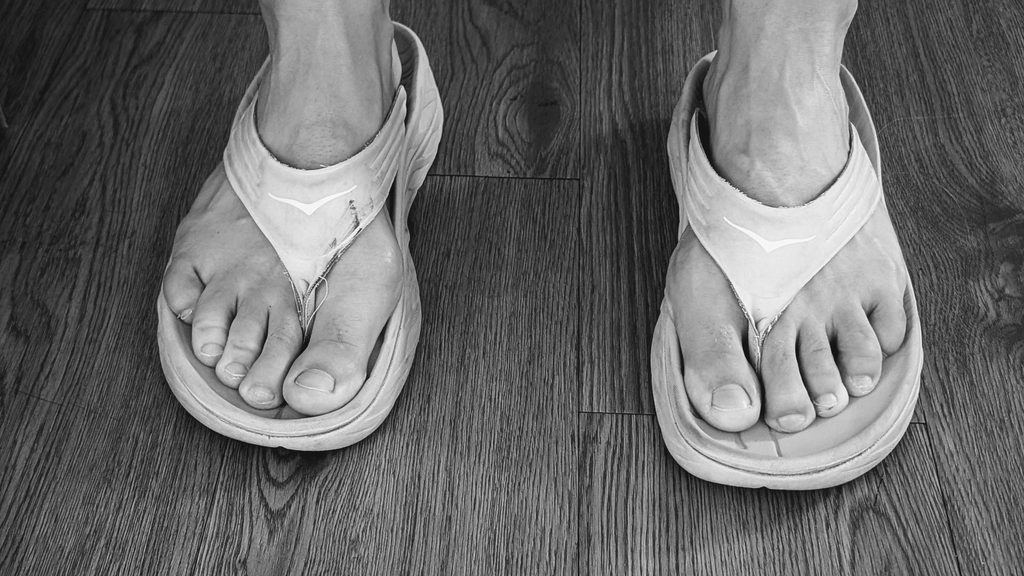
I wear my Hoka Ora Recovery Flip Flops after my cricket matches, long runs, and track workouts. They force me to slow down because they’re so bulky.
Types of recovery shoes.
Every big shoe brand sells recovery gear now and most of it is butt-ugly. Recovery shoes are usually chunky, dorky, and faux-futuristic.
Some of the main types are laceless slip-on shoes, mules, slides, and flip flops. I think the mules and slip-on shoes also defeat their own purpose. A crucial part of recovery is yanking my tight, sweaty socks and shoes off, and letting my feet breathe as much as possible. Any shoe-shaped-thing sounds constricting after a hard workout or hot cricket match.
Recovery slides and flip flops are plumped up versions of the open-toed sandals we all know, and Hoka makes both: the Ora Recovery Flip Flops and the Ora Recovery Slide 3. The Slides are way more popular than their flip flops. However, I can’t wear slides because of my wide feet and pressure on my injured big toe.
Thus, a cushioned flip flop is my ideal recovery shoe: it has the least constriction, the most airflow, and still tons of cushion underfoot.
Hoka ORA Recovery Flip Flops versus OOFOS
Hoka’s recovery shoes owe some of their lineage to OOFOS sandals. I haven’t tried OOFOS footwear, but several of my fellow cricketers wear them after matches, and both brand’s flip flops carry the APMA Seal of Acceptance. They’re both good for your feet and their basic tech is quite similar, though the Hokas tend to be firmer and more stable than OOFOS.
If you can’t find the Hoka flip flops for cheap, you might have a better chance of finding the OOFOS on sale. The moral of the foot is: you really should invest in a recovery shoe, even if you’re not a Hoka fan.
Price: The Hoka ORA Recovery Flip Flops are relatively expensive.
$60 is a far cry from $1 Old Navy flip flops that I used to walk around the entire sun-soaked summer in. But the build on the Hoka Ora Recovery Flip Flops is also about as far as you can get from those cardboard-flat thongs.
The Ora Recovery Flip Flop is a recovery device, rather than a walking shoe. It’s literally in the name. So you’re paying a premium to put on a shoe after you take off your other shoe, and the new shoe helps your foot feel better after running around in your other shoe.
$30 Hoka Ora Recovery Flip Flops are the real deal.
Beyond that, the Ora Flip Flops are quite durable. I’ve read a few user reviews about the toe-thong snapping off, but my personal experience has been the opposite. I bought the pair you see here on clearance from Campsaver back in 2024 for about $30. These are my only pair of sandals and I wear them daily. I tossed my flat thongs so I wouldn’t be tempted to wear them.
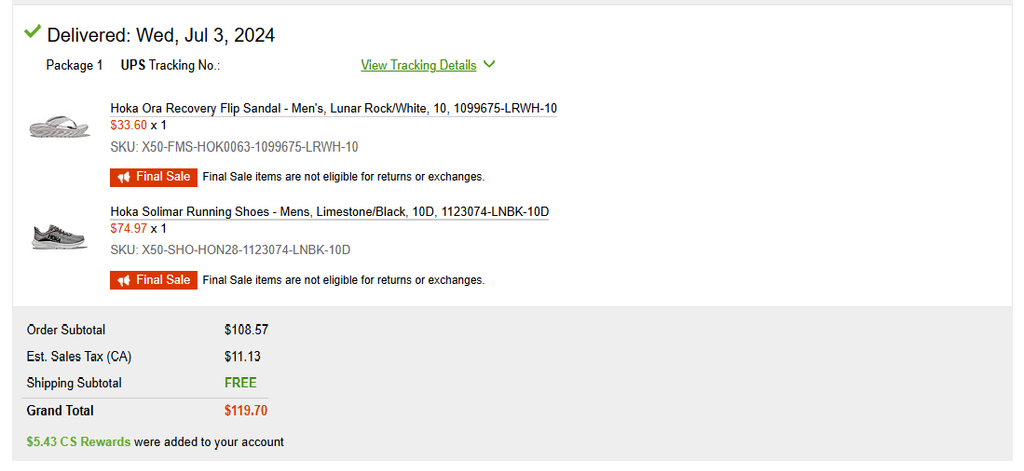
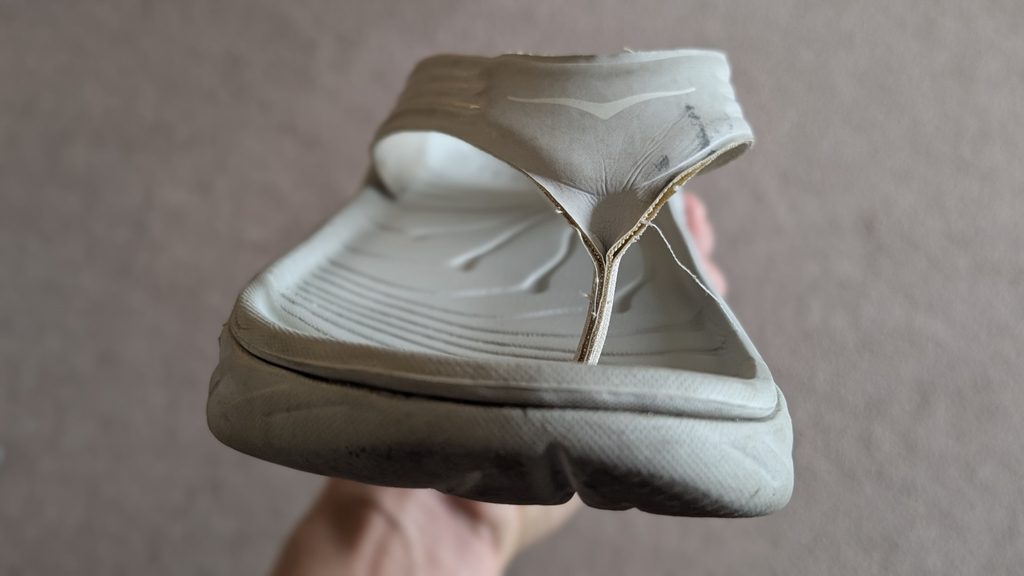
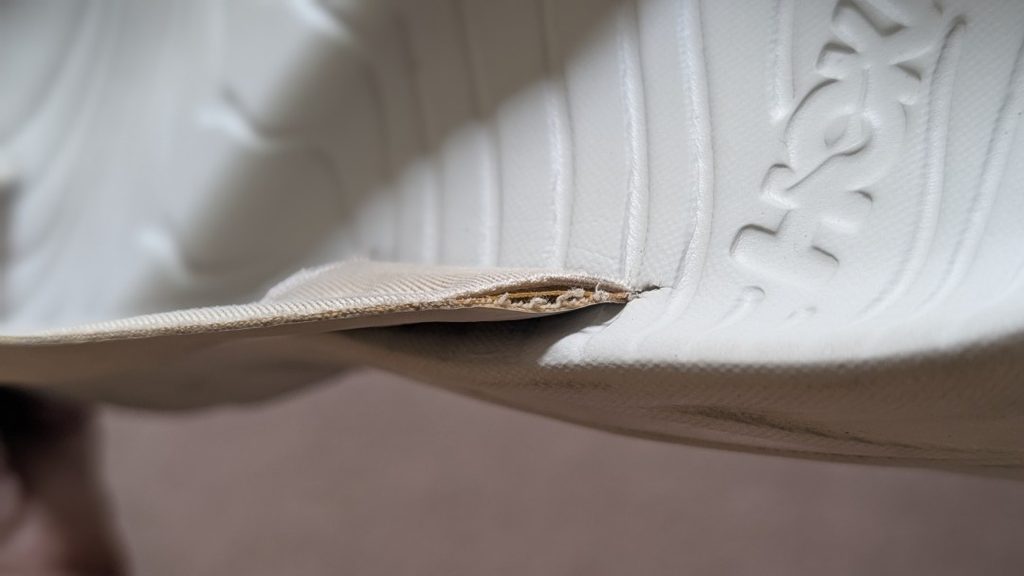
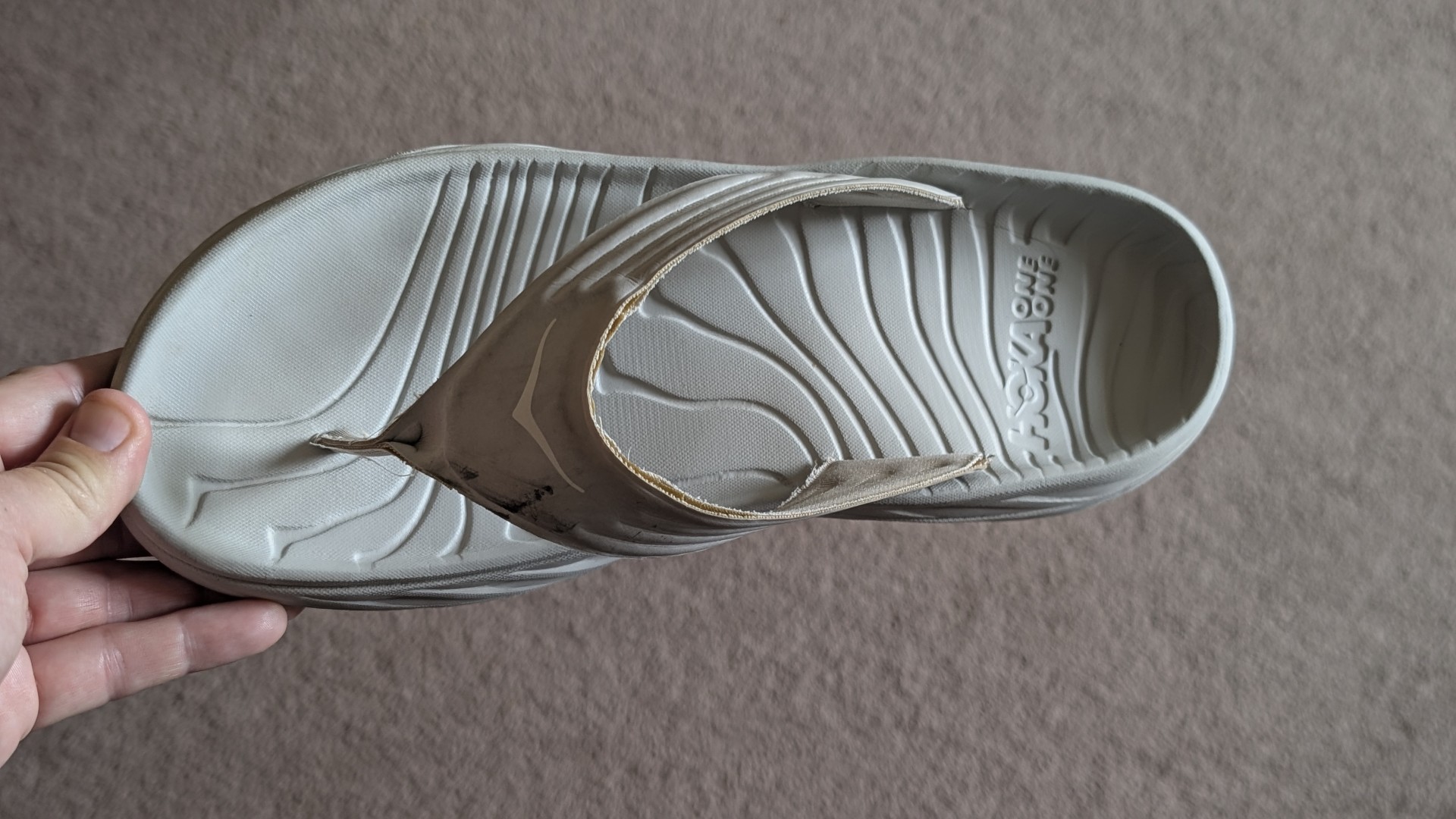
The straps and the toe-post is peeling a little, but in terms of actual sandal substance, these Hoka ORA Recovery Flip Flops are still soft and solid. I actually want them to break so that I have an excuse to buy a new color. But alas, they obstinately march on.
All this being said, don’t settle for paying full price for the Hoka Ora Recovery Flip Flops. You can always find Hoka shoes on sale, especially if you look a little. Anything around $40 and you’ve got yourself a fantastic deal for a pair of ugly, durable, and perpetually comfortable sandals that will last at least two years.
Comfort: These recovery shoes feel good by contrast.
In other words, I don’t immediately feel the difference if I put them on after shoes. I feel the delight of my foot decompressing in the open air, but the cushion is similar to a lot of my running sneakers. The real contrast is compared with being barefoot on hard ground, or versus regular old sandals.
Tech in the Hoka ORA Recovery Flip Flops.
The Hoka ORA Recovery Flip Flops have Hoka’s familiar compression-molded EVA foam oversized midsole, so it feels like my feet are in their rightful place. It reminds me wearing an open-air version of the Cliftons. They’re plush, they’re fat, and they’re comfy-domfy without being heavy.
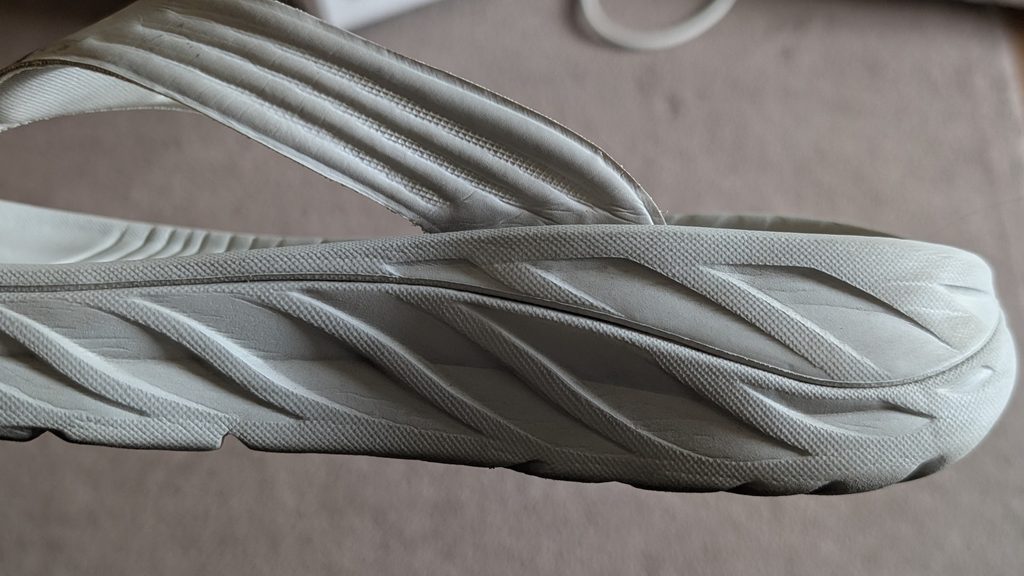
According to Hoka, these sandals also incorporate their early-stage, trademarked “Metarocker.” Rockered shoes are their bread and butter, and it’s the tech that catapulted them to acclaim. Rocker tech helps alleviate plantar fasciitis, and shifts strain off of the toes, Achilles tendon, and calves.
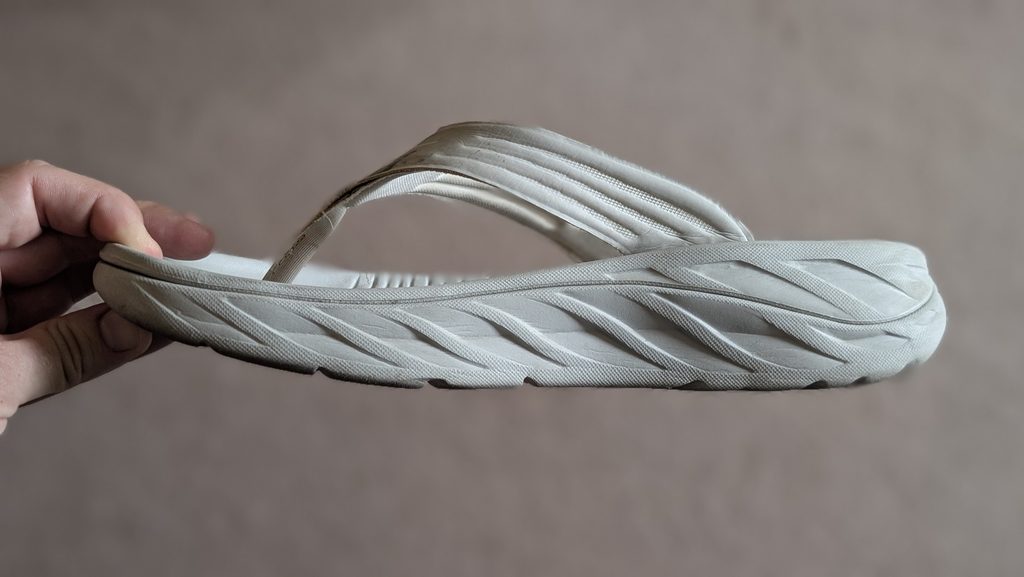
I thought “Early-Stage” Metarocker meant the prototype rocker that Hoka originally used, but it actually refers to where the rocker starts. “Early-stage” starts closer to the midfoot, rather than closer to the toes (late-stage, which is even worse of a name). The result is a smoother walking motion, as one would hope from a recovery flip flop.
The Hoka ORA Recovery Flip Flops don’t live up to their onomatopoeic name — thankfully. That classic FLIP FLOP sound of childhood summers slapping down the asphalt during freeze tag is quite muted here. These shoes don’t slap, they clump and cradle.
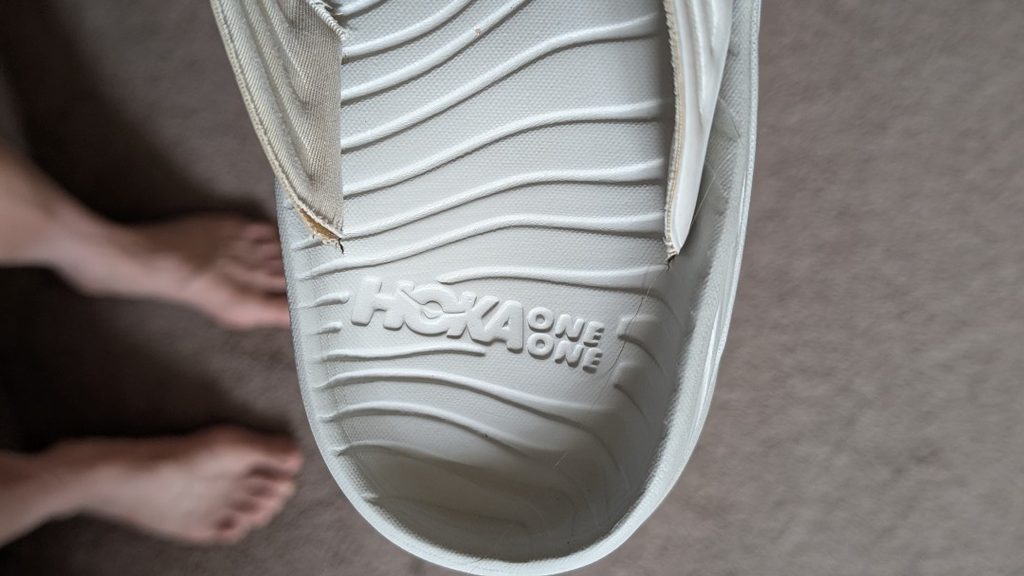
Indeed, Hoka doesn’t mention it on the product description, but I feel like these flip flops also use their Active Foot Frame technology that gently holds the foot. The sandals have a high lip and mellifluous “insole” that cradles my feet, and keeps them from slipping off the base.
Podiatrist-Approved
The Hoka Ora Recovery Flips have a American Podiatric Medical Association (APMA) seal of acceptance. That means podiatrists tested these things and determined that they’re beneficial to foot health. So this sandal is definitely doing something right.
Materials: The Hoka ORA Flip Flops stand out where it matters.
My flip flops of yore included the dirt-cheap, flat ones that smelled like a tire on fire, and “fancy” ones with some-type-of-suede top that slowly started to stink as soon as they got some sweat on them.
Ye Olde EVA Foam.
The Hoka Ora Recovery Flip Flops are miles ahead of those old school sandals. The top layer is a type of soft EVA foam, so it’s gentle on my feet, but it doesn’t get sweaty. I wear these into the showers at hotels on cricket tournament trips and they also dry quite quickly.
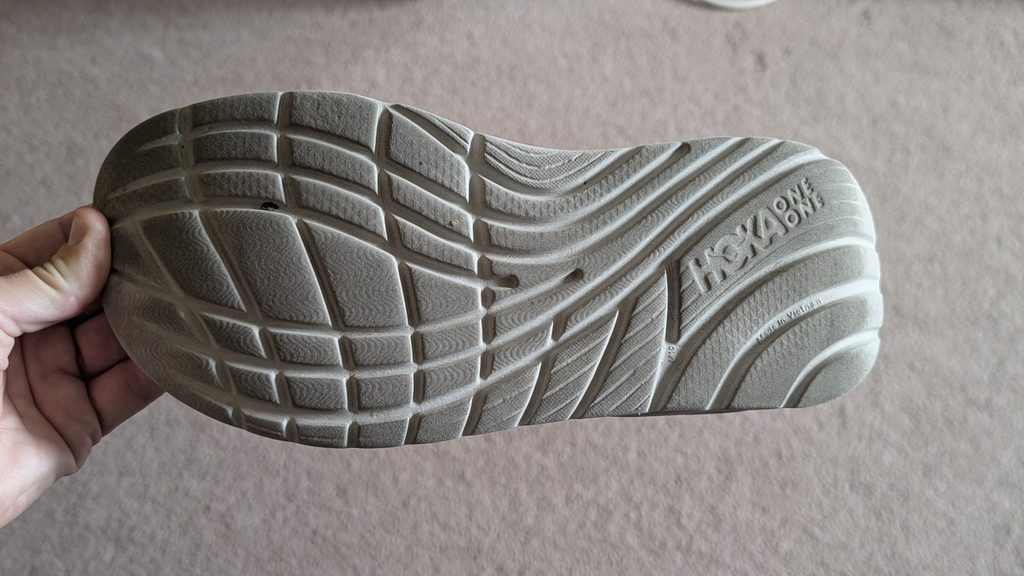
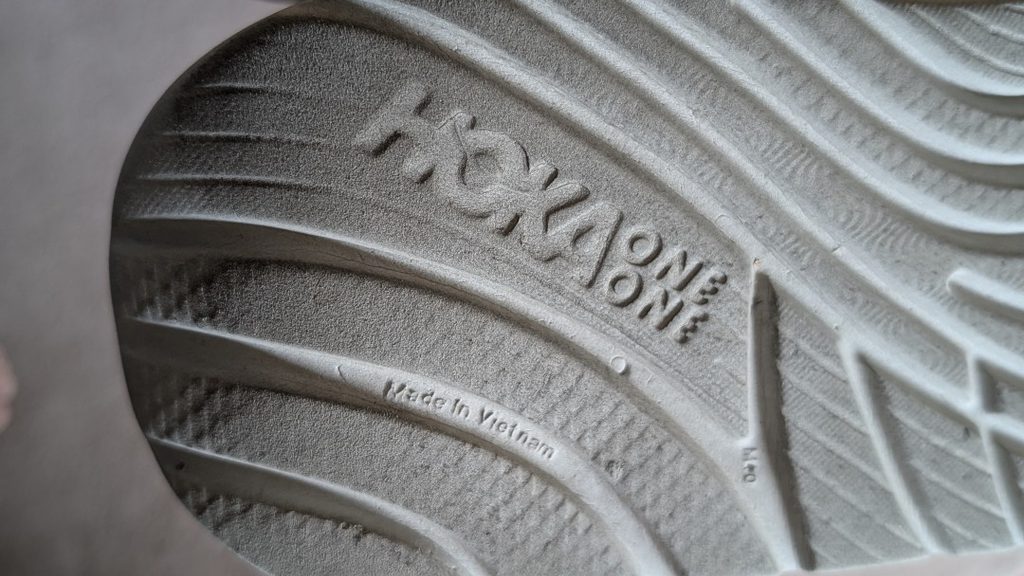
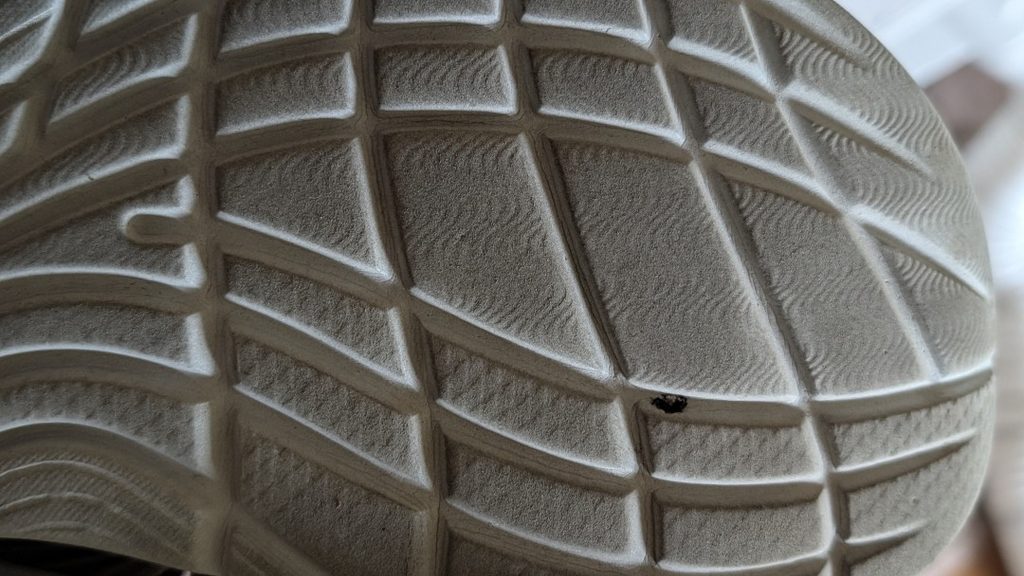
The outsole is a grippy rubber with little grooves in it. They’re worn down, but still visible two years later, which means these things are pretty durable.
An improved toe post.
At some point, Hoka updated the toe post on this shoe for “improved fit and comfort.” I must have the updated version because it’s the comfiest strap I’ve ever felt between my toes. I’ve never had a chafing issue, even when wearing the sandals all day. The bed of the flip flops is also grooved, which prevents foot slippage.
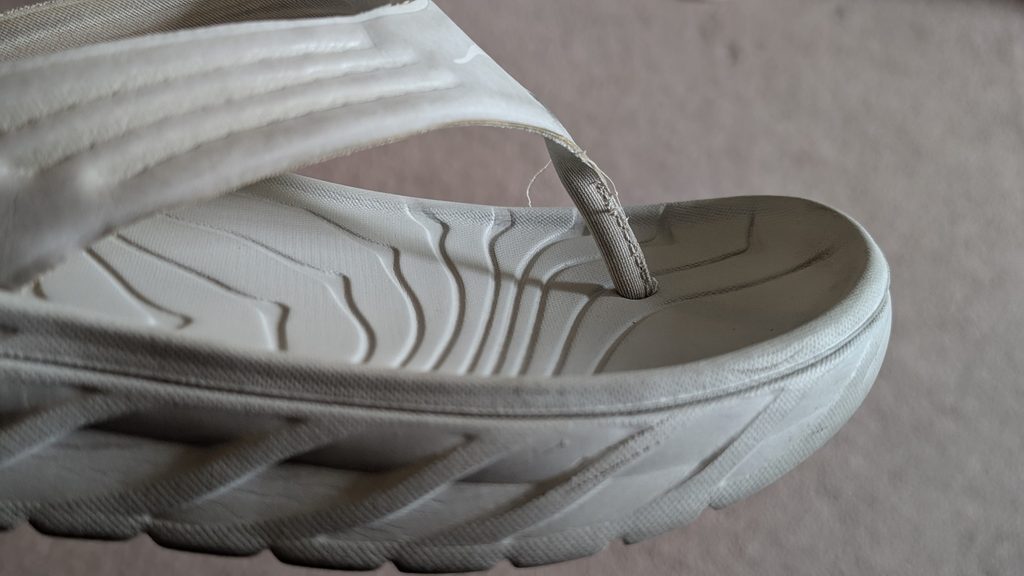
As you can see, the cheapest area seems to be at the seams of the fabric on the straps. They’re coming apart and I vaguely recall this starting awhile ago. But while it looks ugly, it doesn’t affect the shoe’s functionality. The structural softness is still there, three years later.
Size: Hoka flip flops fit like Hoka shoes.
I am of the wide-footed folks and can only wear flip flops. Sandals squeeze the sides of my poor feet like I’m one of the ugly stepsisters trying to stuff my fat foot into Cinderella’s glass slipper.
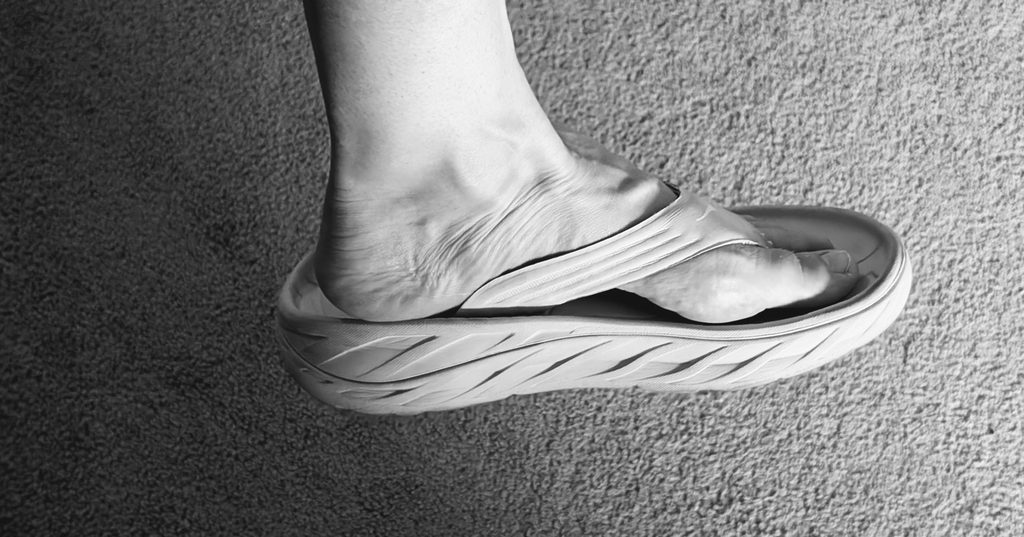
I first bought some Hoka ORA Slides and they were either too small or too big. The Hoka ORA Recovery Flip Flops have room for error thanks to their open sides. I bought my usual size 10D and these fit perfectly. My feet have room to splay.
I must stay that they are a bit bulky. I don’t feel nimble at all in them. I also don’t like driving in them because they’re so big, they can snag on the pedal when switching to the brake.
Appearance: The Hoka ORA Recovery Flip Flops make me look like a dork.
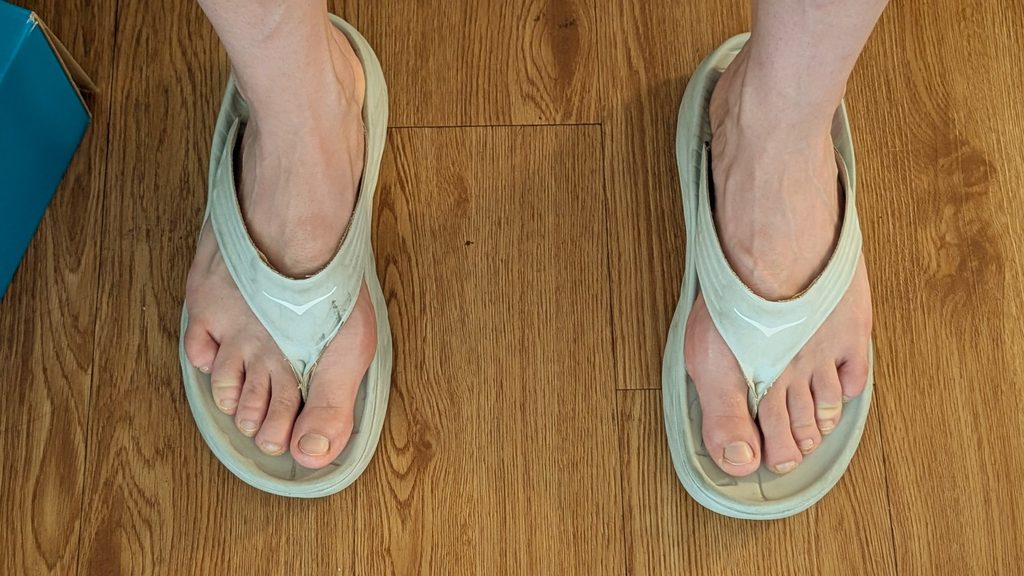
And I don’t care. My feet feel fantastic. I already wear Hokas to work, Hokas to the club, Hokas to fine-dining. I’m absolutely going to wear my chunky Hokas after playing cricket for 6 hours.
That being said, the pale gray color I own does no favors to my ghostly feet. I look like I clomped out of the hospital after a long, delirious illness.
The good part is that Hoka continually releases new colors for these sandals. Yes, even as the sandal itself remains impervious to change (except for the pesky toe-strap), Hoka has dropped new colorways for this piece of recovery gear.
Mine are still going strong, three years in, which is more than good enough for a $30 shoe.
The Hoka Ora Recovery Flip Flops Are Everything I Didn’t Know I Needed in a Sandal
Hoka has mitigated all of the annoying things from traditional flip flops: flat, hard, loud, and prone to snapping. They’ve also elevated the flip flop in the process: their Ora sandal is soft, comfortable, and promotes a smooth step. Fifteen years ago, these sandals would have been inconceivable. Now, they’re an everyday part of my life and boy, do my feet feel better.

You Might Also Like
-
Hoka Ora Recovery Flip Flops 2-Year Review
They ain’t pretty, but they’re the most reliable piece of footwear in my closet.
-
The More I Look at the Hoka Solimar 2 Shoe, the More I Hate It: A Review
The 2026 release is not a worthy successor to the original Solimar everyday trainer.
Leave a Reply