

Hannah H.
As an Amazon Associate, we earn from qualifying purchases. This post contains affiliate links, and if you buy through them, we may earn a commission at no extra cost to you. We hand test every single product on this site because we’re nerds like that and only recommend ones that actually perform well.
This low-cost tool allows you to practice cricket anywhere with zero other equipment.
I love hardball cricket, but I don’t love how hard it is to find places to practice. Batting at public parks is nerve-wracking because the leatherball can do serious damage to unsuspecting bystanders.
It also can do serious damage to my own body, so hardball practice also means lugging my full kit around.
Then there’s the issue of surface: bounce the leatherball on concrete for more than a few minutes and it looks like a dog chewed it up.
There’s no perfect substitute for a real cricket ball. However, we played with a synthetic cricket ball recently and realized it was way less lame than we thought. In fact, it’s one of the cheapest, most useful cricket practice tools we tried.

What is a synthetic cricket ball?
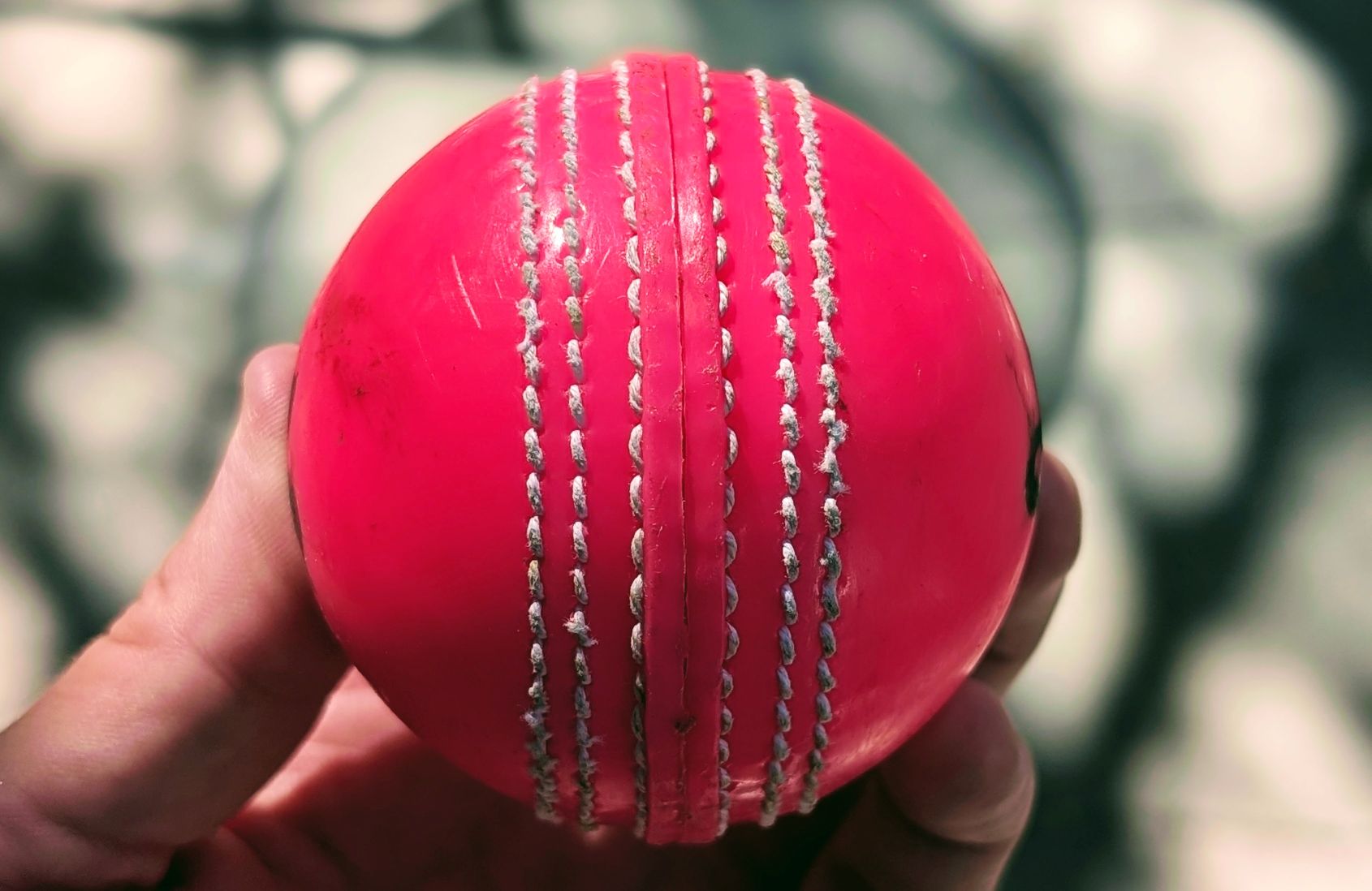
It’s a plastic (typically PVC) cricket ball with a rubber or foam core. It typically has six rows of real stitches like a real cricket ball. It also has the expected seam/equator running through its center.
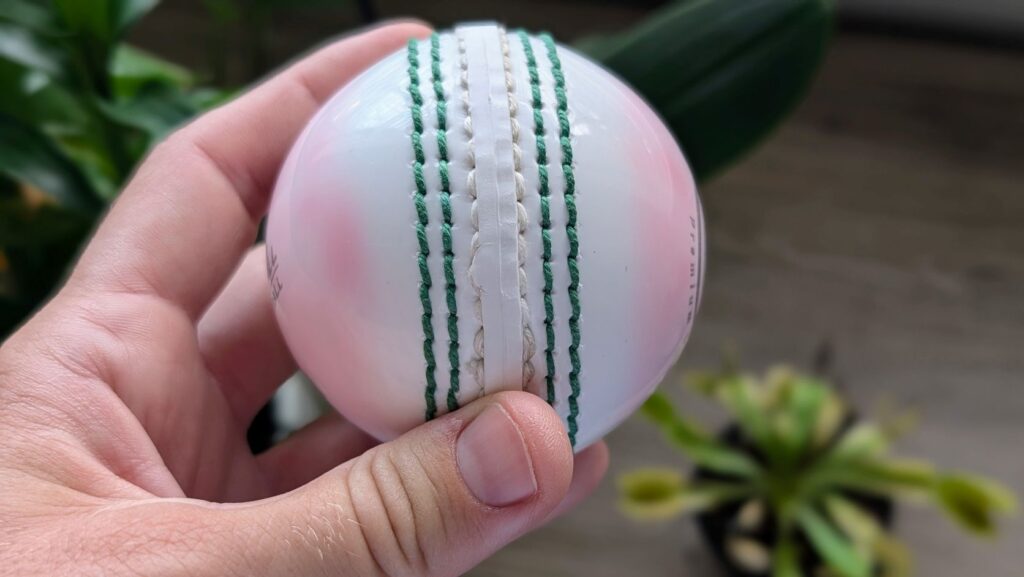
A synthetic cricket ball weighs around 90 grams (men’s). A hard cricket ball is made of leather with a cork core and weighs around 156 grams (men’s).
The circumference of a synthetic cricket ball is akin to a leatherball, but it can vary by brand. Hardness can also vary between synthetic cricket ball brands. Compared with a leather cricket ball, a synthetic cricket ball feels less dense and has some give if you press the plastic really hard.
When gripped, a synthetic cricket ball feels like a hard cricket ball thanks to the seams and stitching. It also bounces and moves similarly to a leatherball, with some caveats.
The synthetic cricket ball was created as a training tool for beginning cricketers, but it’s now a favorite among all levels of cricketers — including us.
Why do you need one?
1. To practice indoors anytime — even at night!
Every so often, we have the bright idea of tossing a leather cricket ball around inside the apartment. The second it thuds against a wall or careens towards the window, we know we’re idiots.
That’s not the case with a synthetic cricket ball. It has enabled us to practice literally anywhere and anytime, including in our small living space. I still wouldn’t throw the synthetic cricket ball full force at a TV, but overall, it’s way safer than a leatherball.
Since it’s plastic and foam, I can bounce the synthetic ball off the apartment walls. It barely makes a sound and it doesn’t leave any marks. This makes it ideal for solo catching practice.
It’s also more authentic than a tennis ball (I tried that before). The synthetic cricket ball mimics the texture, size, and bounce of a hard cricket ball. It bounces decently (and quietly) on carpet/hardwood floor. I’ve been practicing my wicketkeeping hand-eye coordination in my hallway with it.
Finally, since it can bounce without taking off some plaster, the PVC ball is also helpful for practicing defensive batting form: don’t swing, just defend.
2. To practice outdoors anywhere.
Synthetic cricket balls can also be used in pretty much any outdoor space.
Hard surfaces.
In particular, they excel on hard surfaces, such as basketball and tennis courts. The ball bounces well, comes in fast, and it doesn’t get damaged by the asphalt/concrete. Bonus: if there’s a fence, you now have an impromptu batting cage.
The fastest bowler I personally know practices every evening with a synthetic ball on a basketball court. The synthetic ball really opens up a new world of cricket practice: cul-de-sacs, empty parking lots, playgrounds, etc., are fair game.
If you have access to a synthetic wicket, the synthetic ball also performs well on this surface thanks to the concrete below. It also doesn’t deteriorate like a leatherball starts to do as soon as it hits the ground.
While the bounce and swing nuances won’t be quite like the real thing on an artificial pitch, such a pitch isn’t match-grade in the first place.
Grass.
Usually we have to clear a wide berth for batting practice on public fields. People love to daydream five feet away from the hard ball flying at their temples.
With a synthetic ball, we can safely play in the middle of a park. The ball has less bounce and it doesn’t carry as far, but it’s good enough to practice bowling, batting, and fielding basics.
3. To practice without getting hurt.
The best part of a synthetic cricket ball: nobody needs to bring their kit to play. Some of the biggest barriers to playing cricket are:
- Cost of equipment.
- Lack of access to facilities.
- Fear of injuries.
The synthetic cricket ball solves all three of these issues. In the past, a lot of our first-time players quit leatherball cricket after just one session because of how painful the ball was. Once it hit their finger and they feel the aching zing in their joint, they were done for life.
We’ve switched to the synthetic ball for newcomers. With it, they learn the proper techniques to minimize their injury chances once they level up to leatherball cricket. For example, they’ll learn how much give to give to the ball when catching.
I keep a synthetic cricket ball and an old cricket bat in the car because I can play pretty much anywhere now, no kit needed.

Get your own synthetic cricket ball.
What’s the catch with a synthetic cricket ball?
Every hard cricket ball that I’ve seen people practice with is a warped, mangled blob. If that’s the standard, the synthetic cricket ball will suffice just fine for 95% of players.
Cricket snobs will say that it’s inconsistent and it doesn’t behave like match conditions. While that’s true, it’s also true that most people don’t have access to cricket facilities that mimic match conditions.
Similarly, the surfaces that everyday cricketers play on are also usually riddled with holes, high grass, mud, and poo. A hardball does nothing that it’s supposed to do in such conditions.
So if you’re looking to find the fun in cricket, or you want to hone certain techniques like fielding form, a synthetic ball is more than good enough.
It’s also cost-effective. Since it doesn’t get damaged, you don’t need to replace it as often as a leatherball. The downside is that a synthetic ball won’t swing in the air like a real leather cricket ball does when it/because it wears down.
All in all, I really like how the synthetic cricket ball enables me to practice anywhere. Any cricket practice is better than no cricket practice, especially for beginners.
Which synthetic cricket ball should I buy?
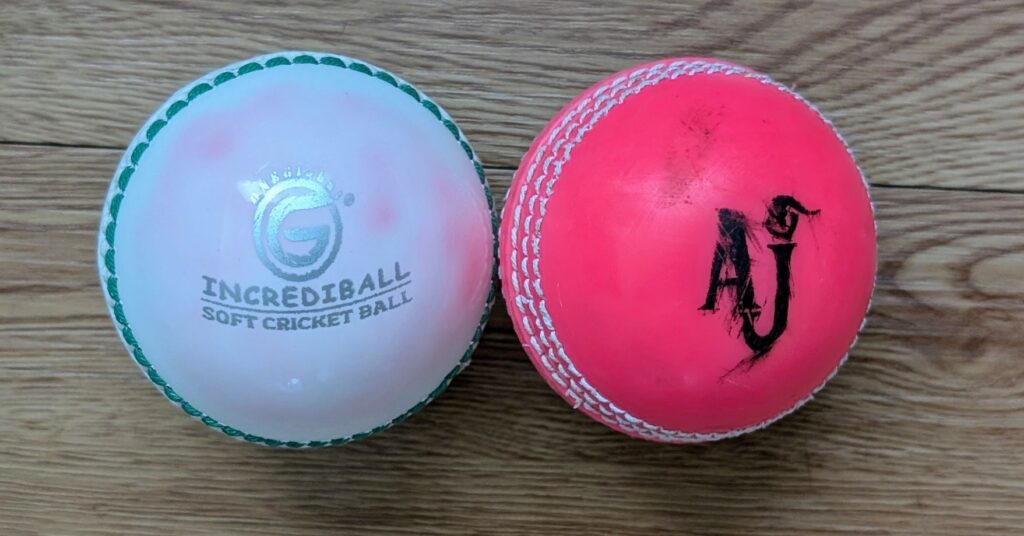
As Shakespeare said, “An Incrediball by any other name would work just the same.”
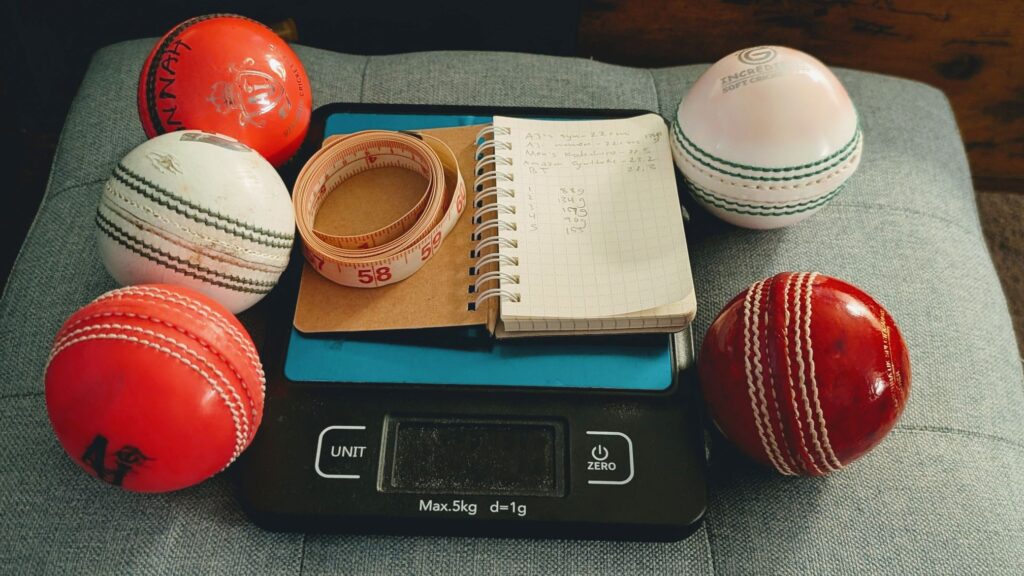
The quickest, easiest option is to buy ONEGlobal’s Incrediball from Amazon. However, in our measurement tests, it’s fatter than a regular cricket ball. It measured a chonky 23.2 cm whereas a hard cricket ball averages about 22.5 cm.
The PVC is also quite hard and taut. This means the ball is bouncier, as you can see from this bounce test versus our synthetic cricket ball from AJ’s Sports in London.
Ultimately, the differences are minimal. Every cricket store and brand has their own version of this ball. For example, Omtex sells a Pro-Soft Ball. I would choose whichever one you can get cheapest and buy some extras to keep in the car.
We actually prefer the AJ Pro Match Incrediball. It’s a little softer and feels a little denser. We have the junior size, which is about 22 cm and 88 grams.
Synthetic cricket ball field-testing thoughts.
I’ll admit, in-hand, our synthetic cricket ball initially felt pretty lame. It’s missing the density and weight of a cricket ball, and I thought it was just going to kind of waft and wiffle-ball around.
In action, it’s surprisingly good. We played on a front lawn with windows and cars all around. We felt comfortable flinging this thing everywhere without worrying about breaking anything, including our bones.
Fielding practice:
Excellent. We used it to hone our catching technique without bruising a finger. At high speeds/the wrong angle, it still gives a decent sting, but nothing like an actual cricket ball. This is a good thing: we focused on catching instead of flinching.
Since it’s about 70 grams lighter than a cricket ball, and plastic, it actually requires better collecting technique: it’s slightly more prone to rebounding out of your hands.
Keeping practice.
Best-use scenario. This ball is perfect for keeping practice. We set up with a spigot as the stumps and wore zero gear. I practiced my stance and how to receive the ball with soft hands.
As Dinesh Kharthik explains, keeping is all about repetition. A plastic cricket ball enables budding keepers to practice everyday.
Bowling practice.
Good enough. The six stitched strings allow for a proper grip on the ball. We didn’t have to force the action to get the ball to move through the air. It also bounces up off dirt/grass. It’s not a 100% reliable bounce, but I felt it was better than a tennis ball, which bounces way too high.
Batting practice.
Good enough. The synthetic cricket ball is near-perfect for practicing defensive shots. It’s also good for practicing batting form elements such as grip, footwork, focus, etc.
It begins to lose some oomph when you swing for boundaries and sixes: it doesn’t go as far in the air, and it doesn’t roll nearly as far as a regular cricket ball. On the plus side, we didn’t have to run as far to pick it up.
Synthetic cricket balls are way less lame than you think.